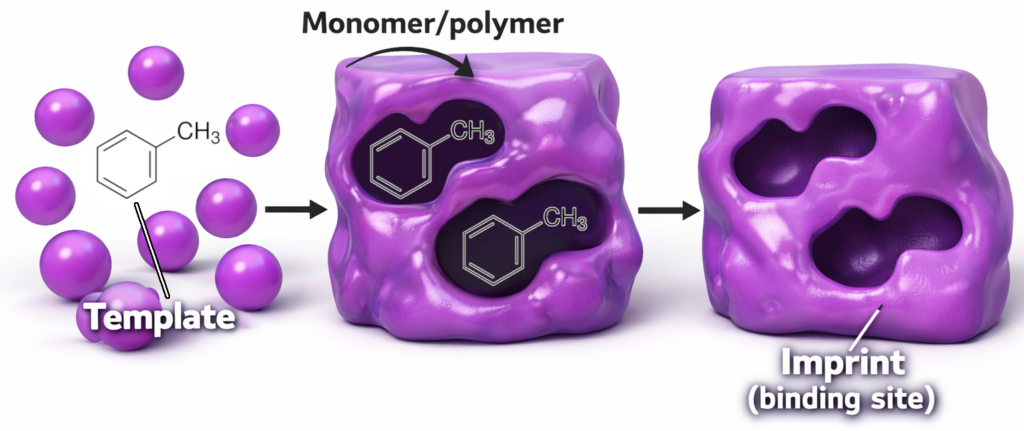
Molecular imprinting is a process of inducing materials to retain cavities which complement specific molecules.
This is achieved by using the molecule as a template; the material is drawn enthalpically around the molecule. Strengthening of the material allows the shape of the molecule to held in the material long after it has gone.
Molecularly imprinted polymers
Molecularly imprinted polymers (MIPs) are materials with binding sites which can bind a specific molecule with high affinity and selectivity.
Synthetic olfaction
The use of molecularly imprinted polymers in gas sensing is an established science, but under-explored. We intend to find its limits.
Plastic antibodies
Nanoparticles with molecularly imprinted binding sites allow us to produce synthetic receptors and antibodies; these have been described as “plastic antibodies”.
Nanomedicine
It has been shown that nanoMIPs can be used to remove poison from blood and other applications. Could they be future treatments for viral infections, cancer, and even aging?
Imprinted biopolymers
Previous studies have mostly used synthetic monomers to produce MIPs. Can these be repalced with biopolymers (proteins, sugars) to make biocompatible and sustainable BioMIPs?
Ripples in sand
Anything that happens in the lab could happen outside the lab too. To what extent are MIPs formed in nature, and what are the implications of this?
Primary research interests
Our previous research has ranged from the development of advanced biomedical and analytical technologies to fundamentals of chemical science. The current focus however is in two specific areas:
Molecularly imprinted polymer gas sensors
Selective volatile organic compound sensors
Biomimetic synthetic olfactory receptors
Precision sensing of the air around us
Mechanism of molecular imprinting
Improving technological performance
Fundamental, interdisciplinary science
What does the Earth remember?
Men’s evil manners live in brass; their virtues we write in water.